
On this ride, your hosts Steve and Mal hurtle from Point A to Point B while mulling over the siren song of “They Don’t Want You To Know,” the merits of finding a trust/mistrust balance, and the art of the con.
To leave a comment, click here
Show notes:
Tina Majorino, who played the character Deb in the excellent movie “Napoleon Dynamite,” was one of the few non-Mormon members, or perhaps the only non-Mormon member, of the cast. (The name given to the llama in that film was Tina. Coincidence? You decide.)
William Goldman’s book about Hollywood is entitled Adventures in the Screen Trade. An article in Variety about his iconic observation in that book, “Nobody knows anything,” can be found at https://variety.com/2018/film/opinion/william-goldman-dies-appreciation-1203030781/
A long list of conspiracy theories [Ooof!] can be found at https://en.wikipedia.org/wiki/List_of_conspiracy_theories. As can this statement: “Many conspiracy theories relate to supposed clandestine government plans and elaborate murder plots. They usually deny consensus opinion and cannot be proven using historical or scientific methods….”
For a fascinating list of cons, see the article under “Scam” on Wikipedia: https://en.wikipedia.org/wiki/Scam. That article also includes a delightful compendium of scam lingo: “Other terms for ‘scam’ include confidence trick, con, con game, confidence game, confidence scheme, ripoff, stratagem, finesse, grift, hustle, bunko, bunco, swindle, flimflam, gaffle, and bamboozle.
“The perpetrator is often referred to as a scammer, confidence man, con man, con artist, grifter, hustler, or swindler. The intended victims are known as marks, suckers, stooges, mugs, rubes, or gulls (from the word gullible). When accomplices are employed, they are known as shills….”
And there, too, can be found this observation
“Confidence tricks exploit characteristics such as greed, dishonesty, vanity, opportunism, lust, compassion, credulity, irresponsibility, desperation, and naïvety. As such, there is no consistent profile of a confidence trick victim; the common factor is simply that the victim relies on the good faith of the con artist.” (Emphasis added.)
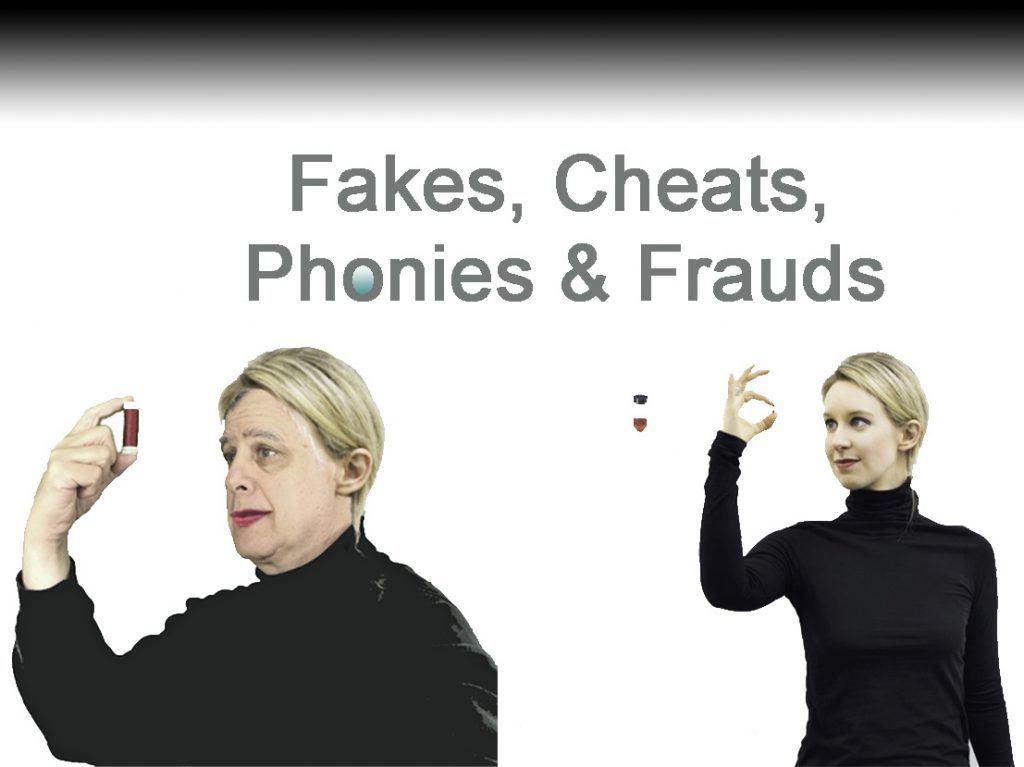
As to an exploration of what goes into a fraudulent scheme, why not check out Steve’s excellent foray into podcasting several years ago, the lone episode (so far) of “Fakes, Cheats, Phonies & Frauds” online at https://www.youtube.com/watch?v=wABCVboEZTQ In that recording, Steve dissects Elizabeth Holmes’s Theranos con and, having done so, treats the listener to his version of a fraudulent investment sales pitch for the (nonexistent) indie film, “Distant Pigeons.”